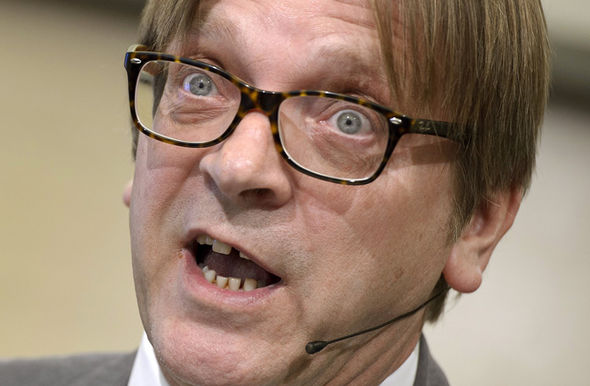
Listening to the MEPs in the European Parliament debating changes proposed by Guy Verhofstade the Belgian MEP (who has been given the role of heading the EUs negotiating group to put the EUs position regarding Britain's withdrawal) one is drawn to the conclusion that Europe and its Parliament are made up of a rich combination of people who represent populations drawn from all corners of the Union, historically who are very different in their specific political journey.Verhofstade has a mission to federalise and centralise the system under the banner of the unelected Commission with a "business as usual" proposal which try's to ignore the rise of nationalism and the two tier economic schism which has gripped the north and the south of the continent.Like the "First Past the Post" system in the UK, which is clearly biased and undemocratic, the EU Commission steam rollers its will on the representatives of the national populations which make up the continent and not unnaturally, there are, as in all nations, many different views, many different claims, many different interests.In a purely national parliamentary setting these differences are more local specific, more home grown and the problems, whilst still largely binary, with little common ground there is always the hope that at the next election you can vote them out and rectify the wrongs and inadequate's by new imperatives.In the European setting "compromise" was part of the balm which made the system work. The regulations and the uniformity, the conformity of principles of practice, these were the great achievements of the EU. Common laws towards employment, protection of safety through rules of working practice, information regarding food, common laws to arrest criminals, removal of tariffs and the creation of common standards for the manufacture of goods, all this was to the good.I have often been at odds with people over here in the UK, carping on about the rules emanating from Brussels since I have little or no trust in my own government to protect my interests. Witness the deliberate dismantling of the NHS and the Social Care provisions we have built up since the War.Europes main Achilles heel is also its strength. Having a separate executive as relieved the need to bring along all the time the competing interests of 28 member states, each with such divergent agendas and priorities. As long as there were advantages for the majority the interests of the minority could be swept under the proverbial carpet but once the minority became large and growing, it has created its own, inter related national following and threatened the so called unity, with the potential threat of other Brexit style withdrawals.We are all indebted to the creation of Europe as a collective of States which historically had fought between themselves but which now stand, as they do today, within one building to debate their differences. It has taught us all, if we care to see, the 'commonality', which can lie behind European nations so long as the people of those nations are consulted and is more important than the petty differences which used to perpetuate the quarrelling.Listening to Hungarians, the Poles, people from Finland as well as Germany, the Dutch and Italians all those disparate cultural identities. Latvians and Lithuanians, Rumanians and Czechoslovakians, people who cling to their ethnicity but now begin to see themselves as Europeans as well.It is still tenuous of course and people with ambition can wreck to plan. The ambition of Nigel Farage, Gert Wilders or Marie Le Pen just as much as Jean Claude Juncker, Barroso and Prodi. Each has an agenda, one camp the polar opposite to the other. One harking back to the time of nationalism the other desperate to leaver nationalism out of the way and create a super-national federal establishment which rules outside the constraints of the nation state.Sadly I think the way it has been done, by slight of hand and subterfuge, building monetary union before proper unitary political union, shoehorning nations into a Union, a collective which was always going to be unequal without establishing the props and responsibilities which proper Federalisation brings. The Commissioners, playing the long game, deceitful and opaque. Making rules which certain powerful nations could break for political convince but rules which were rigidly enforced when the country was weak and desperate.Like so many things, a wonderful concept, bastardised by power, wealth and influence.
Thursday, 23 February 2017
The EU debate
The Process
Subject: The process.
It's a process not an accident. This economic experiment which, since Richard Nixon decoupled the dollar from gold has embarked the Free World on Free Trade economics with ever decreasing restrictions or controls, eventually plunging the world into the Lehman Banking crisis, a contagion which we have never recovered, despite the band aid of Quantitative Easing.
Turn the clock back but no they say you can't turn the clock back. We can't go back to the old days of financial stability, of people living within their means. We have to feed consumerism, that trick to empty wallets and buy things we never knew we needed.
Who turned the clock forward and, on the back of consumerism, decided to supply the credit struck consumer with cheap goods made in countries on the far side of the globe whilst our own factories closed and the workers from those factories were thrown on the scrap heap to exist on benefits which only now, as the second stage of the great experiment takes place and we discover we can't actually afford the people on benefits.
Who became the arbiter of who would be the winners and who would be the losers.
The design, mapped out in the boardrooms of Goldman Sachs and their ilk had a not so complicated scheme in which economic power was largely removed from national politics and its concern for public interest, by the application of the global market place supplied by global players to peruse global interests
What happened to the national interest. The nation interest was sidelined. Governments bought into the concept of everlasting growth through expanding markets which could only be created by moving the source of production into these potential markets. The global wealth was shifted on purpose to stimulate global rather than national wealth.
Where were the local people fighting for the national interest. Once the shift in power moved from parliaments into the banks and sovereign funds, located where the oil money consolidated, like a monitory slick with nowhere to go but back into buying the parts of the old systems national artefacts and securities at prices which eradicated the local to second or third tier onlooker.
Who sold us all the dummy of internationalism. The concept of looking beyond ones own boarders and visualising the potential of a business venture has been with us from the days of the silk trade. A legitimate barter of skills for raw materials is as old as man's first settlements and proved the great socialising force for communities to gather together. Internationalism, as the name predicts, is predicated on national entities recognising one another as individual entities. It's this recognition and respect for the national character which makes the history of international trade such a long one.
It differs from Globalisation in that in the global system boarders and national States become superfluous. The trades are between autonomous businesses, businesses free to choose their domicile, to invent and reinvent themselves, to own no allegiance to anyone other than their shareholders. They are a layer above the layer of the state there are few rules other than the ones they make for themselves, they are the Masters of the Universe.
Who invented Globalisation. Well they did. Robert Rubin. Henry Paulson. Lloyd Blankfein. Alan Greenspan. Ben Bernanke. What do they have in common, Jewish parenthood and strong links to Goldman Sachs. Does this make for a conspiracy, who knows but it certainly looks suspicious and with the diaspora spread across the globe, it would be convenient for a group who hold themselves as 'chosen' to chose to exclude others, simply for being 'the others'.
How do you recognise a Welshman
Subject: How do you recognise a Welshman.
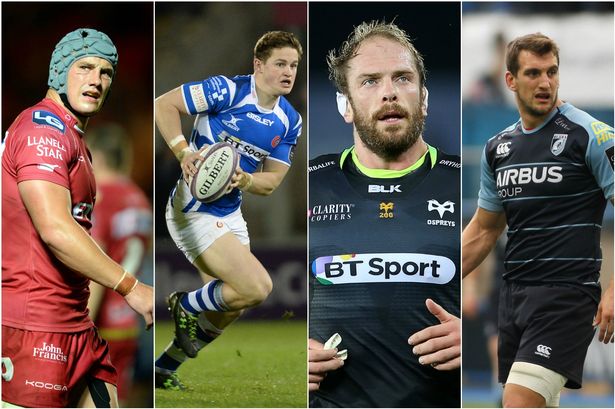
Do you remember the days when their were "15" CJ Stander's in the South African side.
Of course now a days he plays for Ireland and today has been a devastating force in the side playing against Italy at number 6, the blind side Flanker. Of course in this global village if your granny lives in Kilkenny or Bologna, Dumfries or Cardigan Bay even Basingstoke or Limoges then your in the side and there are South Africans players all over the Northern Hemisphere playing for one or other of the national sides.
One has to wonder why the cream of Afrikaner manhood is not playing under the cloudless sky's of the Highvelt or are they ? The South African team have failed to show their old majesty, they lack the intensity, the brutality, the win at all costs mentality. Back then the shear hostility was evident in all their games, it was the result of a febrile hostility the Afrikaner nation carried in its psychology after being caned by every nation in the world because of Apartheid. The political imperative translated itself onto the field as they threw themselves into the ideological breach trying to make up for the hypocrisy of many nations, especially the Americans with their own breed of separatism as witnessed in the 'Deep South'.
This week we have lost at the age of 45, one of the the great scrum halves, Joost van der Westhuizen. His kamikaze bone crunching tackles on the huge New Zealand winger Jonah Lomu were frighteningly awesome. Who would have the job of stopping that 18 stone freak of nature Lomu but Westhuizen and he did it with heroic courage. Sadly
both men are no longer with us, both dying in their effective prime, yet another example of life's lottery.
England scraped a win against the Welsh in Cardiff this afternoon in a great match one which swung this way and that. A draw would have been fairer but with that awesome crowd on their side, singing to make the rafters shake it must be worth points before the ball is kicked. I turned the volume up full blast as they sang the anthem and cheered that stocky 'self belief' in themselves, when up against that old foe England.
It wasn't quite enough, but considering the financial resources England have within the game of rugby, the innate ability this tiny nation has to play with the oval ball, for me, ( a sucker for the underdog), always leaves a wry smile in anticipation of my next trip to the "green green land", home for 50% of the Wood family, so it can't be so bad can it ?
Saturday, 11 February 2017
Being optimistic
Subject: Being optimistic
As all the bodies organs slowly shut down and lose their effectiveness through ageing the brain still maintains its optimism. Of course in the sad case of Alzheimer's and other forms of dementia there is an equally disastrous dissembling of faculties which are as traumatic as the heart or the lungs packing in but on the whole we die from other failings in our collective body apparatus, not from the brain giving up.
The optimism, planning for tomorrow, the emotions which have stayed with us in tact throughout our lives still function regardless.
Running for the bus, as we used to, has an immediate response from the heart or lungs and they soon remind the brain they are not up to it. Anything to do with balance is suspect but the brain doesn't know yet as we take to the dance floor to re-enact an old romance stimulated by a tune from the past. It's only when we try to execute that pivot that we are brought short and flounder. Playing for the Dads against the boys in the school tournament, the young lad approaches with the ball at his feet, will he go left or right. It doesn't matter really since your reaction time is so slow you are constantly wrong footed.
And yet we continue to order books to give us purchase in understanding the world around us. We listen to programs with interest about the economy in 2020 or worry about the rate of global anything. We behave as if there is no tomorrow.
It's far better that way of course since pessimism about not being around, would be suicidal and the very beauty of optimism is that it is optimistic regarding all matters, even if reality will disprove the optimism.The brain therefore ploughs on disregarding the facts. It was ever so of course since in its 'alter ego', the mind, it always lived in a bubble of its own making.
Casting around in a slurry of presumptions, it is besieged by romanticism, a calling for things gone by, of values no longer relevant.It lives in the surreal world of yesterday, trying to adapt to today, and frightened of tomorrow.
Experts
"Experts" the world is awash in experts. One of the problems with experts is that they live in their own bubble, they consume there own prognosis to the extent that they can't see what's happening in front of them.
In the field of politics the experts endlessly pontificate about what politicians think and how they are manoeuvring to cut their colleagues down to size. Columns of words are written by the columnists virtually every day with their media shadows appearing on our screens, on the hour each hour repeating 'ad nauseam' the experts tittle tattle.
So much weight is given to the 'pollsters', another bunch of experts, who examine the polls and base their predictions on a carefully chosen cross section of the populous who are asked to comment about their intentions. A little like the weather, human emotion is very complex and extremely difficult to predict. Politics for many is based on emotion and not rational thought and so we see the swings between what the public tell the pollsters and what they do when they enter the voting booth. Never the less, being experts, they 'tell' us rather than advise and we have seen time and time again, most spectacularly in the last general election when they were predicting a hung parliament which the Tories won quite easily.
In the sporting arena I am constantly annoyed to hear the experts expounding from their predetermine script, unable to see what is happening on the screen in front of them, unable to adapt their fixed pre evaluated opinions.
You see in front of your eyes events unfurling, perhaps in a marathon, where the favourite is dropping behind but they continue to plough on and speak as if the favourite is still a contender, as if what we see on our screens isn't happening, commentating from notes they have prepared beforehand.
I suppose we all do it in one way or another, we all script our reaction to most comments by responding with an "appropriate" response rather than thinking on our feet and sometimes being controversial in calling black, white or deliberately going against the flow of the company you are in to speak of your own convictions.
Fair dinkum
Subject: Fair dinkum
Why is sitting and watching mid day television "so not the thing to do". What is it in our mania for fulfilling schedules that doing zilch is so frowned on. Why can't we watch television all day until we fall asleep in front of the set and then drag ourselves off to bed to dream.
In reality life is just a dream, a mystical series of events over which we have little control.
Throughout our lives like automatons we get up to the alarm clock and hurry off in our car or on public transport to fulfil someone else's agenda. Even precious time at home, is scored through with the usual chores and often we have to walk to someone else's drum beat.
Even in the latter stages of ones life we are expected to wake up and fulfil each day with a busy schedule. Cleaning, mowing, feeding, and only then do we feel that we have achieved our personalised goals which through years of conditioning, allows us to feel good about ourselves. Our ownership of our personal space and the condition it is in often reflects what we want others to think about us. The big house, the flashy car, even the neat lawn and the colourful flowerbed are all the dance we perform for others by which we feed our own ego.
Consider this. If, at the behest of others, we spend in our lifetime, 96,000 hours doing stuff demanded by someone else, perhaps spending the time we have left, 29,120 hours doing what ever we please, is fair dinkum.
St Crispin's Day
Subject: St Crispin's Day.
It has been for many reasons one of the strangest political phenomena, this exit process of Britain from the EU.Last night the House of Commons voted my a large majority to continue the process to leave the EU regardless of the fact that many politicians disagree with the People's Referendum and its vote to leave. It's not an academic question, for many of them they see an economic disaster looming ahead as we lose the right to trade without tariffs barriers for the goods we produce in this country and sell to Europe. Our trade with Europe is by far the largest and so it is from an economic point of view like punching yourself in the face, something you can still decide to do but will hurt and under normal circumstances is unnecessary.So why are the so called custodians of our decision making so gung ho to commit us to this questionable 'self harming' situation.Well "The People have spoken" is the answer and in the Referendum they voted to come out. It has been argued that the People didn't know the facts or understand the consequences of their vote and no doubt with the claim and counter claim swirling around it was exceptionally hard to make head nor tail of what these consequences were. There was a large rump of people who feel discarded by politics who's economic position is dire anyway and have felt discarded by politicians of both the main parties and who therefore took a kick at the government of the day, who's professed wish voiced through the Prime Minister was to remain. To these people they felt their lives couldn't get any worse.Trade is pivotal for economic well being, less trade and ones well being is sure to be effected and whilst everything is in the air at the moment and depends on the concessions wrung from the Europeans there is no doubt our well being will be effected negatively. Why then did the parliamentarians not vote against our referendum decision they being the guardians of our best interests.It has often been said the if "hanging" was left to the popular vote that it would be reintroduced for specific acts of murder. In this case the parliamentarians see themselves as guardians of or morality and consistently vote against the reintroduction of hanging. In the field of "assisted dying" we are often amazed that the sight of people so broken by an illness who wish to end their life under very carefully contrived conditions are rejected this humanitarian wish by the politicians who fly against the wishes of the people. There are hundreds of laws enacted which fly against the popular vote so why not this one if the politician sees leaving the EU a disaster ?Why in this case are they so craven not to vote against the three-line whip which is an order from their leadership to follow the leaderships decision.You would have thought that the guardianship we entrust to them on all matters would make them follow their conscience or economic gut and say no irrespective of what it might do to their political career.Of course I have placed the worst case scenario of our Brexit leave and it is to be hoped the agreement will not be all bad. There is also the gradual build up of trade in other parts of the world but make no mistake this "European Free Trade Area" as it was originally conceived to be, was a tremendous idea and the concept to which we originally wished to enter. It has been the political progression that has begun to trouble people in this country as the Union tried to approach a closer federation with legal and monetary union.In Britain, with our island mentality we were never wholeheartedly within the mindset of Europe, refusing to join the Euro for instance and so I think it was more being the reluctant relative that drove the vote in the direction it did. For many political and economic reasons the thrust of European decision making has come from predominantly Germany and historically it sticks in the gut to think that after two world wars, when Germany represented an alien ideology, something we were so opposed to that we were prepared to send our lads to die to oppose, that we would calmly accept, 50 years on, their unquestioned leadership.The economic instability of a two tier Union of States, strong North, weaker South without the recycling of surpluses as is seen in the USA, a proper federation of states, then the economic disharmony within Europe would only flourish with the disaster of systemic unemployment the only outcome. This almost, built in, unequal structural aspect of the EU was to my mind something to be avoided and since the hegemony within the union had already been established it would not easily be relinquished.It was for this reason that I wished to leave but I have to be frank, the full implications of for instance, 'financial pass porting' was never explained, nor its implicit ramifications on the strongest element in our economic structure, the Banks.
Henry Vs St Crispin's Day speech before the battle of Agincourt
This day is called the feast of St CrispinHe that outlives this day and comes safe homeWill stand a tip toe when the day is namedAnd rouse him at the name of CrispinHe that shall live this day and see old ageWill yearly on the vigil feast his neighboursAnd say 'Tomorrow is Saint Crispin'Then will he strip his sleeve and show his scarsAnd say 'These wounds I had on Crispin's day'
Subscribe to:
Posts (Atom)