Thursday, 4 May 2017

Crossing the line together.

Subject: Crossing the line together.

What fine specimens of articulate manhood, the English marathon runner who had over extended himself short of the finishing line and was collapsing as his system closed down and his saviour the Welshman who selflessly stopped running and achieving his own time to help this chap to get across the line.
Interviewed afterwards one felt they were both "salt of the earth" as they explained their reminiscence of the event. It was so refreshing to see the bare bones of running camaraderie exemplified in this way, so refreshing after the days of hyperbole and down right avoidance of what we understand as truth, as the politicians embark on their election 'story telling'.
Human endeavour is what elevates our species to do the things it can feel proud of. Sport is often a signpost although with the cloud that doping brings, not all athletes are motivated by their innate will to win within the confines of their own ability. Money and fame distort the human desire to be acknowledged for being good at what they do and like, power is to politics, it blemishes achievement. 
The politicians seem immune from telling porkies. It's a recognition of their success in the trade if they can, with straight face and without any sign of an ethical tick tell downright lies. The lies might be laced with genuine thoughts that what I am saying is something I want to happen but it doesn't excuse the truth which invariably makes their desire only part of a wish list, something a child would send to Santa.
One has the sense that the politician who least likes lying and therefore is the most exposed to ridicule and derided is Jeremy Corbyn. When asked a difficult question on disarmament for instance he can not put aside his life long belief that nuclear arms are simple too dangerous and should be banned. There are many reasons why this can be questioned but you have to admire the man for not sidestepping his convictions. It is so un-political and as the leader of the opposition it puts him in a nearly impossible position. As a populous we don't seem to want the truth we would rather be fed half truths since this bolsters our view of the world and the place we have within it.
The truth is unpalatable. It means changing the way we live our lives and insists we rationalise our hopes and bring it more into line with the reality around.
Since as human beings we find bad news something to be avoided we fixate on good news even if in our heart of heart we know the news is a sham to make us feel good.
The politics of at least one party is so encompassed with providing benefits which effect only a small section of society and yet appeals to a much larger section on the proviso that the political contract also has something for us, irrespective of historical data which deny this. Yet we live in hope, a hope born of the snake oil seller.
  

Making another culture our own.

Subject: Making another culture our own.

We are rightly concerned about hurting others. In a balanced caring community we try to evoke amongst its members a sense of letting be, by that I mean we recognise that people are different and have for a myriad of reasons and other points of view.
In a mature society we insist on freedom of speech within the law and would be dismayed if someone denounced our right to disagree with someone, particularly with the governing class who's modus operandi is to pursue politically objectives that are not always our own.  The balance we observe is largely based on 'reciprocity', an exchange which has at its heart, mutual benefit.
Societies today are becoming more and more complex as ethnicity, culture, religious affirmation, a proclivity towards sexual preference, complex gender issues, and so much more, as the dust on the heels of those seeking to join a society come from all corners of the world and who's affinity is purely an economic one.
Politics these days try's to represent all reaches of society, not only the core values and in its attempt at being open handed it is often open to conflict from the sections it wishes to appeal to as well as those who are ignored and left behind.
Labour is in a pickle because it has voters, some of whom voted to come out of the EU largely because of open door immigration (free movement of people) which had put tremendous pressure on the Health Service, Schools, Employment and generally where ever a service provision is made to the people. Others within the party see the economy being hit so hard that the immigration issue will fade into insignificance if we don't find a market to trade into.
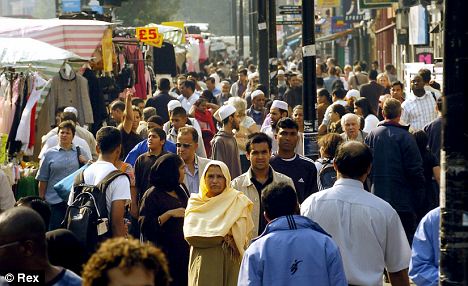
UKIP have stung the middle class commentators by drawing issue with the insistence of the Muslim population to demand the wearing of the Middle Eastern, Burka on the streets of Britain. The security gained by seeing someone's face and reading their acquiescence or resentment and one presumes their intention, is something which in a court of law has been a prerequisite of the trial. The suggestion also that the Burka precludes any sort of integration and leads to ghettos being formed where women do not learn the language or mix in society, still less are able to go out to work, has no place in a modern Britain. But the "rights" we decree to all get in the way.  We seem oblivious of the fact that the Muslim population is doubling every 10 years, 9 million by 2020 and will make up 50% of the population by 2050. This wouldn't be so controversial if they were not seen, tied as they are by their strong religious adherence, to be a consolidated group who speak with one voice. Their insistence of conforming to Sharia Law is already a fact of life within the community, a fact to which we close our eyes for fear of social disruption but of course the disruption later will be greater unless of course we turn over and capitulate.
Foreign culture whilst richly informative is the result of many things, not least of which is time. Culture is an organic expression of the norms which describe a society and religion plays an enormous part in identifying the values within a culture.
Chinese culture is ingrained with the philosophical acceptance of Confucius who instigated, within the society, a system of social and ethical awareness.
Japanese culture is likewise indebted to Shintoism for its inter personal respect.  Countries who practice the Muslim religion are seen at odds with the conflicting interpretation of Shia and Sunni, seeming incompatible towards each other, an incompatibility taught at home to the children who grow up hating the other sect. Christianity is still hugely influential, particularly in South America in the guise of Catholicism whilst the foundation of a mix of evangelical and orthodox Protestants vi with Catholicism in North America.
Each religion or philosophy is entrenched in its belief and so long as the beliefs are contained to the geographical areas where they are strongly represented all is well.  But bleed that influence across boarders and continents, one begins to see the inevitable displacement of the indigenous culture, with un-fortelled consequences.
The advent of mass communication, mass travel and the instability of North Africa has meant that the cultural bleed is now a haemorrhage into Europe and the cultures of Greece, Italy, France and Germany are being placed under tremendous strain. The strain is leading to a rise in nationalism and closed borders and was the catalyst for Brexit.
The liberal elite are caught in a bind with their Athenian consensus of a freedom based on democracy which itself relies  on the law to make democracy work. If laws are in place but the politicians dig their heads in the sand, it is left to law enforcement to take the strain but who have over the last few years taken a beating as the "human rights" lawyers run rings around them and made them frightened to act for being accused of racism.
It's a rum old world and unless we clearly define our own character and the institutions that define it we will eventually have to take on another.

I am, therefore I think.

   
Subject: I am, therefore I think.

It is suggested that consciousness is nothing more than a "peripheral sensation" amidst the whirring of the synapses within the brain. That our consciousness is the last to know what we are going to do. We are in a sense,  dummies trying to keep up with events outside our control.
How did consciousness come into being. It is suggested through language and the need to think outside our own box as it were. This realisation that there was life outside our own box led us to evolve ways of thinking about peripheral things which as time went by became more and more complex. This led us into the world of supposition, a grey world of artificiality where fact and fiction mix. That there can be reasons without reasoners, designs without designers and competence without comprehension.
"I think therefore I am" famously described an assumption but if our minds are simply a jumble of thoughts and the "I" is nothing more than a 'centre of "narrative" gravity', a sort of story we tell ourselves to make sense of the jumbled narrative created within our minds, then to be conscious of who we are is a fake.
It is all rather devastating to imagine we are based on so much 'quick sand' with few or any foundations.
Our reasoning subjects us to believe "we", as represented by our mind, centred within our body, is for real and therefore this reality, as an individual, demands respect. But what if the real reality is that we are a composite of chance happenings, fired off within the mind with no coherence other than the false image we put in place to come to terms with not actually knowing who we are.

Thursday, 20 April 2017

Its only indigestion

Subject: It's only indigestion

"Ignorance is bliss" of course and there is no truer truth than when one closes ones eyes, head on the pillow and a twinge of pain catches your attention. Dr Goggle is consulted and any one of a number of reasons, from the acute to the benign causes one to pause and think.
'In the past' without any self knowledge a pain was par for the course, nothing to worry about, if it gets worse place it in the doctors hands. Life was, in some ways, not so precious.
Two horrendous world wars had made a mockery of the sanctity of life and some how we were content with 55 to 65 years as a good innings. I was walking through a grave yard the other day and noticed that 50 years was the average at the turn of the 20th contrary and these were substantial memorials to the dead and must have represented the better off who would be expected to live longer.
Today we are searching for immortality by postponing death to await improvements in medical science so our bodies can be repaired. The technical apparatus handy to the medic today encourage him or her to use what's in the toolbox irrespective of the quality of life since we have been directed into 'specialities'. The lung man, the heart woman, the brain team, each speciality outbidding  the other for funds to promote what they do.
Look how good I am cry's  the abdomen guy, little realising that his success has huge implications up and down the food chain. The saving of life is not just the impact of a replacement but the overall effect that that replacement brings to the body corporate.
Life is finite, death is forever and no matter how we wish to doge the issue, we do ourselves a dis-service if we don't prepare for the inevitable.
How we do that is different for each one of us. Faith plays a great part for the many who believe we are part of something greater than the sub total of our being. People without faith must rely on being pragmatic and wish the end to come without pain, reconciling the inevitability with thoughts of having hopefully lived a good and full life.
And so the pain we feel tonight is only an example of the complexity of a function which has carried on for 70 or more years. Enclosed in a body which has been misused and ill-treating itself for decades and whose elasticity of purpose is fast running out.
Luckily there are pain killers in the cupboard and anyway, it's only indigestion !!!

Democracy

Subject: Democracy

With Teresa May calling a General Election in June, it seems to me that rather than an election about party priorities it will be an opportunity to return a vote as to whether we should leave Europe on what ever terms are offered or if the terms are so bad perhaps we should reconsider.                                                                                               Voting in Scotland has become simply a nationalistic call for ridding themselves of the chains of Westminster and much less than on bread and butter issues.                        Tim Farron of the Liberals sees it as I do an opportunity to send another message to the political elite in Westminster about staying in the EU, he of course has raged at the referendum result since it was announced and one could expect the "Remains" to lend him their vote. With 49% of the electorate recently coalescing around remaining in the EU one would have thought his singular political party opposition to leaving would draw a huge following since, as I say this election following a divisive Referendum will be seen by many as a one issue vote.
Sadly the Labour Party have been all over the place with so many of their core voters wishing to leave the EU and many wishing to stay.  It meant that Jeremy Corbyn had to relinquish his own preferred opposition to Europe and its cartels and try the difficult balancing act of re-establish a middle position on the matter. Of course in politics this is seen as fence sitting and there is nothing worse for someone who proclaims he has leadership potential.
If people who had voted against Brexit reduces significantly the Conservative vote can they continue to proceed with the Referendum vote. Would it mean, cap in hand, to ask for our letter back. The Europeans would probably welcome us back as a wounded force, put in our place as it were and something of a laughing stock.
The doom sayers would heave a sigh of relief, especially the financial markets who see untold problems in our leaving since we learn more and more, how tight the is knot which ties all national economies these days, Not as it was 10 to 15 years ago when individual nations counted in the general scheme of things.
National agendas have been overtaken by Global agendas. Economic Groups such as the Europeans, China, America and to a lesser extent Russia, India and the Brick nations have a collective strength which far outweighs a single country the size of ours and so, as welcome as it is to cast our minds back to Empire, I think we have missed that boat.
That's not to say that we are in a canoe without a paddle only that we might consider  downsizing our self esteem and begin to think, like many smaller nations, about our own society and how we can revive it, instead of worrying about other societies far away on the other side of the world. I believe that we, like them have rights. Although I hate the term rights we should not be afraid to cherish the institutions which give us our special kite mark. The NHS, unarmed police, a respect for not only the laws but the systems which bring those laws into being, an ability to largely get on with all the people who come to live here, a deep accommodation without sacrificing norms for those who proclaim they are different to us in what ever way, a respect of the sick and elderly, an admiration for the youth who cleave out new ways to get to where they want to be, and so much more. This is the mark of a mature society, a society who should not be told what to think but should be admired for the instinctive way it ploughs its their own furrow without disturbing the neighbours.

Where do you get your information

Subject: Where do you get your information.

The man in the "Dog and Gun" has opinions obtained from aspects of his daily life and rightly bases much of his decision making on what he learns. Obviously his expertise is limited to where he/she sources the information and the creditability of that source.
One of the complaints people made leading up to the Brexit vote was the limited and very poor information on offer leading up to the vote and the use of political chicanery to try and persuade the voter one way or the other.
The BBC spend, a considerable amount of money broadcasting what goes on in Parliament. The discussions in the various committees which invite the people deeply involved in the issues to come in and be questioned on their specific expertise.

Today the Group Chairman of HSCB, the Chief Executive of the London Stock Exchange and the Vice Chair of Allianz Global Exchange were sitting and answering questions in one of the committees. Their knowledge and expertise on the financial ramifications of coming out was of the highest quality. The opinions and reasoned argument were edge of the chair stuff and I wish more people would watch and listen to these broadcasts rather than taking their position from the Daily Mail or the Guardian.Yes it's heady stuff.
Xavier Rolet the top man in the Stock Exchange was explaining how since the banking crash in 2007 the system was changed and rather than allow banks to clear their positions themselves in direct contact with who ever was the counter party, the system now is handled centrally in a 600 trillion dollar clearing house where all the deals are brought together and compressed into a multi currency settlement process. There are two centres London and New York which cover the world trade.
Douglas Flint the big boss of HSCB and Elizabeth Corley, a very articulate and savvy Vice President of Allianz added their wealth of experience to answer the often sceptical MPs about any specific downside to Brexit.
Another session had the boss of Air Bus and alongside him, the the leader of the Motor Vehicle Manufacturing Association.
These are not the sort of people you are likely to meet in the "Dog and Gun" and if you were willing to stick the course, you learn from the horses mouth, what actually we can expect depending what agreement is reached and what opportunities, if any, arise.
It should be compulsory on schools to feed this sort of discussion forum into their 6th form at the very least since they are going to be the ones having to deal with the Brave New World post exit.

Its not for life

   
Subject: It's not for life.

The Erdogan Referendum on whether to consolidate the position and the powers of the Turkish President with those powers held by the Prime Minister has revealed what a divisive  system Referendum can be when the voting is close. 
Brexit had a similar close result and given the importance Referendum questions have on a country it seems a binary vote, "yes or no" always gives an incomplete answer. 
All voting system leave winners and losers and if in the round the outcome is divisive  usually there is hope for the losers that in time they can have their say and reverse it.
Referendum unfortunately seem to be a totally different political device since the outcome is deemed irreversible. Can an outcome, which is irreversible be judged by a single vote on the bases of a single question on the ballot paper.
Given that the question on the ballot paper matters to people and given that 51% vote 'yes' and 49% vote 'no' how can any sort of consensus be reached between winners and losers. 
Instead of winning the issue by repeated debate and compromise it provides a stark contrast and inevitable conflict within the society, a conflict which simmers with resentment, rather than coming to terms and acquiescing. These acute differences can, in volatile societies become the seed for civil war and even in our own mature society the result of the Brexit vote will not begin to be revealed until the end of the two year negotiation and the position we are in is revealed.
Little has happened since the vote other than we have learnt more about the negative implications of our voting to get out of the EU. This learning curve has taken place after the vote when common sense tells us, it should have taken place before. 
As the implications come out in a drip feed of debate, we become in a better position to make a valued decision and at least having evaluated the consequences, we can't cry when things go belly up.
Referendum then are a rough tool to gauge a populations wishes. It simply polarises people into camps which re-entrench a position, since regardless of any new facts, to protect the reasons you voted the way you did you hunker down and cover your ears. The implications of what you have done reinforce your blind spots since to admit you were wrong on such an important question as to your future and more important, your children's future, would be too difficult to bear.
Few things have a right or wrong component since what ever is one persons right is another persons wrong and "rightly" so. 
Our democratic system of balloting every 5 years is itself full of contradictions but at least it's not for life.