Tuesday, 10 December 2013
In memoriam
Was the rain symbolic, were the heavens weeping, were the gods unhappy at the passing of Mandela and wished to show ordinary mortals that the occasion had a wider dimension.
The so called great and the good were gathering, walking through the heavy rain into the austere environs of the FNB stadium. Leaders and past leaders, people who had been involved in the freedom movement people who had supported the anti- apartheid movement from the safety of distant countries, rock stars, fund raisers people who, we who lived there, felt were totally misguided and had been brain washed not to understand the other side of the political coin.
The white man's contribution was air brushed out, brushed aside, in fact vilified in favour of ideology. We continue to be nonplussed by the virtual silence the media brings to the mis-governance of the country !!
It was interesting how, when the various South African dignitaries were announced the crowd cheered. Winny Mandela, and the previous president Thabo Mbeki received the loudest cheer, even De Klerk had a strong acknowledgement but President Zuma when announced he was greeted by boos.
I was also intrigued by the blessing given by the four faiths Jewish, Muslim, Hinduism, and Anglican. For me the one which rang true was the Hindu in his simple description of life's journey without the complexity of the story of the Old Testament, the New Testament, and the Koran. The Jewish rabbi went into great detail quoting passages from the Old Testament much of it highly problematic and indulgent of his faith. The Muslim preacher was more to the point but was hardly inclusive. The Anglican Bishop of Cape Town was very measured, very dignified but of course also relied on biblical structure which in the end raises more questions than answers. No, I liked the Hindu who's feet were on the ground who's message was about the insignificance of our desires and the inevitability of the circle of birth and death.
I was very impressed my Mandela's wife Grace Machel. She was clearly deeply effected by his death but she was so serene and looked the picture of a First Lady, she was never caught by the camera in anything but a deep sombre mood. The speeches were, as when ever you give a politician an opportunity and a platform to practice his trade, repetitious and coming from some of them, hollow.
President Obarma made a significant appeal to keep the spirit of Mandela alive to be inclusive of the opposition view point to keep in mind the whole of society and not purely the interests of the influential. Of course the American President holds court over a political system that encourages massive influence from "special interest groups " and has done little to dismantle Guantanamo Bay, one of the most public hell holes, where a man's human rights defined by the American Constitution is flouted by sit'ing the detention camp on foreign territory.
I wonder when he pronounces on his ideals does his conscience trouble him or is that a political oxymoron ?
Monday, 9 December 2013
Madiba
Madiba has passed away and the world’s media is full of his life and times.
A
truly iconic figure, he seemed to have gained a messianic following
fed, not only by feature writers but by a list of world leaders as
varied as Fidel Castro to Bill Clinton all impressed by his innate
ability to be anchored in a set of beliefs that were part of his very
fibre and not the usual political make over. He was extraordinarily
stubborn in his commitment, initially to the African cause and then
amazingly he absorbed the whole nation in his humanity.
If
there was a moment it was when he embraced the winning South African
rugby side and won over a crowd of mainly Afrikaner’s as he shook hands
with Francois Pienaar the captain, who was plainly in awe of this
charismatic man wearing a Springbok jersey sporting the number 6.
Behind
it all, we who lived there have our own memories of living in the
country during the Apartheid years, watching the events unfurl, having
our fears assuaged by a largely Government controlled media, being
convinced we were an important part of a "cold war" conflict that the
Communists were waging in Africa.
South
Africa was a bulwark of the West for many years, Simonstown an
important base for the Royal Navy and the South African Army carrying on
the fight into communist controlled states to the north.
The
Township troubles were cast as part of the communist onslaught and a
fight that had to be fought. The issue of race was all around but was
cast in this ideological conflict rather than the moral issue of the
treatment of people based on the colour of their skin.
We
employed black people and housed them in tiny rooms with the barest of
amenities. We didn’t really consider them or their families in the same
way as we thought of our own families, we came to a pragmatic
acknowledgement that our own needs were pre-eminent and our life style
was something we were not prepared to give up.
Watching
a program, put together by David Dimbleby last night, we were reminded
of the events that earmarked the passage of time from John Vorster
through the Botha years to De Klerk. The Rivona Trial and prior to that,
the arrest of Mandela, the Soweto uprising, and the reports of troubles
in townships we had never heard of, as the State tried to keep the lid
on the growing disharmony. We went to work and had our briaa, we gobbled
our garlic prawns and glugged our Castles Larger, but had little real
interest in what was happening just over the horizon.
The
ANC were demonised and the leaders were persona non grata. There were
rumours that certain business leaders, Anton Rupert, members of the
Anglo camp had gone up to Angola to talk to these terrorists with the
government blowing icy threats in their direction of cowardice in the
face of the enemy.
We
continued to party and were surprised when De Klerk announced the
release of Mandela, Mandela who, oh that guy who we locked up years
ago. I visited Victor Vester Prison (trying to sell them medical packs
containing sterilised equipment ) where he had been moved as part of
the secret negotiation which was taking place between the ANC and
President Botha.
His
release and the inter-party negotiations at Kempton Park were
fascinating, even more so because we, the ordinary public were able to
watch the meetings on TV, so different from the acutely secretive
Afrikaner government who had always known what was best for all of us.
We were now watching black men tying our heads of government in knots as
the sentiment for a settlement took hold and the inevitable became
clear.
Ceril
Ramaposa was the lead man. How could a black man be so eloquent,
looking the part, making the current ministers seem parochial – even dim
!! Behind it all Mandela and De Klerk manoeuvring, trying to ensure
their electorate had a fair share of the cake. It was a last cause for
De Klerk, given the enormous disparity of the vote and the fact that the
voters were lined up in terms of colour rather than the normal party
promises.
Mandela
the statesman who emerged from prison was a phenomenal in that he
captured the world’s attention and was claimed by statesmen from all
corners of the world, of all ideologies as the person they most wanted
to share a platform with. Was he a terrorist, was he a freedom fighter
was he a friend or did he bring our affluent house of cards tumbling
down. Would we whites have been better without him or was he inevitable
and were we simply lucky to have had this peaceful giant on hand to
guide us through the potential turmoil.
Sunday, 1 December 2013
Don't knock it.
Today we turn into the month of December and close onto the celebration of Christmas. Christmas means different things to different people, ranging from sadness to happiness, from inclusiveness to exclusion, from hope to despair. Why is this season, culminating in a few specific days in which there is a collective expectancy to be rewarded by some sort of emotional happiness so important to us. The issue of Christmas, apart from its religious cogitation, pre dates the media/business hype that we are used to these days where we are now conditioned to enjoy and to spend. Our very economy is dependant on the purchasing splurge as people buy gifts for family and friends and of course the stimulation to get out to the shops brings a focus to the high street and the people shopping there. There is a happy glint in the eye, as we think of others and the things they might like to receive on Christmas Day, we move out of our own bubble and think of these others, its therapeutic in a good sense.
Of course for many, when times are hard it is difficult to find the means to fulfil the expectation and it is this expectation and our sense that we are valued by the ability to match up to society around you is the Achilles heel of this time.
It is not an easy time for the individual, the lonely, the excluded and of course, it is difficult for people remembering past, happier Christmas's which, no matter how hard one try's, can not be recreated.
The mawkish sentimentality of the Christmas festivity as it effects a fictional American family on TV is recreated every year ad nauseum and makes viewing nearly un-watchable, (along with the forced conviviality of New Years Eve and peace to all men malarkey !!) But having said that I feel that the effort mankind makes to acknowledge mankind in general is worthwhile, so I won't knock it !!
Friday, 29 November 2013
Cocoon
A cocoon is a protective covering to keep the occupants secure.
Mankind has evolved its own cocoon mentality as we, as individuals move through the various stages of our lives but it is not always a surety that the format which we anticipated would resemble a cocoon as we grow old, will come to fruition.
Life has a knack of throwing up the curved ball and just when you thought that your innings was assured along comes the hitch, the unexpected, the unplanned. How we react to being out in the cold again is a measure of character and a realisation that the best laid plans of mice and men are nothing other than "plans", reality is something different.
The resilience of a person depends on many things not least age and opportunity. When young life stretches out into the future, today's let down is simply the mechanics of of ones existence, changing gear and there's always tomorrow and the day after. The middle years are creative in that marriage and children bring a perspective that we had no inkling about and much was made, on the hoof, learning as you go.
The cocoon was the family and the security one gained by the love you gave and received during that time. Of course the cocoon was based on an assumption that all parties were buying into the experience and that the bonds formed were indestructible.
People come in all shapes and sizes and on many emotional levels. Some are pragmatic, some sentimental, some evolve some dissolve, some find their reason for emotional growth, to be the result of having wider responsibility from the narcissism of youth, some find responsibility difficult particularly personal responsibility when it comes to blaming others for their own short-comings and we all have plenty of those !!
The cocoon is at its most vulnerable when old age arrives and the reality of failed dreams becomes apparent. The instinctive care and the hand holding we all need as we begin our decline, is held as reflecting our journey through life and the friendship that should be there as the bond that kept a couple, a couple.
Too often the bond has been hollowed out and the reason to keep the cocoon in-tact is, in some ways lost or questioned. Of course at a time when the individual is at their most vulnerable the intricate support people lend each other is thrown away with little to put in its place.
Mankind has evolved its own cocoon mentality as we, as individuals move through the various stages of our lives but it is not always a surety that the format which we anticipated would resemble a cocoon as we grow old, will come to fruition.
Life has a knack of throwing up the curved ball and just when you thought that your innings was assured along comes the hitch, the unexpected, the unplanned. How we react to being out in the cold again is a measure of character and a realisation that the best laid plans of mice and men are nothing other than "plans", reality is something different.
The resilience of a person depends on many things not least age and opportunity. When young life stretches out into the future, today's let down is simply the mechanics of of ones existence, changing gear and there's always tomorrow and the day after. The middle years are creative in that marriage and children bring a perspective that we had no inkling about and much was made, on the hoof, learning as you go.
The cocoon was the family and the security one gained by the love you gave and received during that time. Of course the cocoon was based on an assumption that all parties were buying into the experience and that the bonds formed were indestructible.
People come in all shapes and sizes and on many emotional levels. Some are pragmatic, some sentimental, some evolve some dissolve, some find their reason for emotional growth, to be the result of having wider responsibility from the narcissism of youth, some find responsibility difficult particularly personal responsibility when it comes to blaming others for their own short-comings and we all have plenty of those !!
The cocoon is at its most vulnerable when old age arrives and the reality of failed dreams becomes apparent. The instinctive care and the hand holding we all need as we begin our decline, is held as reflecting our journey through life and the friendship that should be there as the bond that kept a couple, a couple.
Too often the bond has been hollowed out and the reason to keep the cocoon in-tact is, in some ways lost or questioned. Of course at a time when the individual is at their most vulnerable the intricate support people lend each other is thrown away with little to put in its place.
Wednesday, 27 November 2013
Who will throw the first stone.
Once again
we are conflicted with an issue that draws acutely differing opinion,
dividing society into the Idealist and the Pragmatist.
The case is the murder of the injured Taliban fighter by his captor, the British Marine soldier. Clearly the soldier was guilty of murder and the argument has been on whether he should be granted anonymity to guard his family from retaliation.
As an aside.
I find it difficult to reconcile the idea that when the State orders you to kill its acceptable, even if the conflict is born of the filmiest political reason and yet deeply held animosity based on genuine ills between people have the full weight of the States Law brought down on them, but I digress.
There are a number of issues which arise. The first is the context. Whether we fully understand the distortion that war brings to a persons understanding of what is right or wrong ?
1. The Idealist would say that there are no conditions which condone violence particularly the killing of an unarmed man and we often use the term in "cold blood" to differentiate a crime of passion whereby the act of killing is deemed to be due to a person who has become unbalanced and therefore they are not in control of themselves.
2. The Pragmatist would point to the battlefield condition, particularly when the war is fought against unidentifiable contestants where every man and women in the street is a potential foe. They would suggest that the soldier through combat is pushed into a mentally unbalanced state, especially if he has just witnessed the killing of a friend or colleague or seen the dismemberment of other troops as warning. When life or death is all around, when the civilised world has become grotesque, who will be the first to throw a stone ?
The second issue is the danger the family it is claimed, are under by supporters of the Taliban in this country. What a sad state we are in when we have to acknowledge that the danger lies within as much as without and that our national concept of homeland and the intrinsic security that being at home should bring, has been demolished by our obsession of being all things to all people.
The case is the murder of the injured Taliban fighter by his captor, the British Marine soldier. Clearly the soldier was guilty of murder and the argument has been on whether he should be granted anonymity to guard his family from retaliation.
As an aside.
I find it difficult to reconcile the idea that when the State orders you to kill its acceptable, even if the conflict is born of the filmiest political reason and yet deeply held animosity based on genuine ills between people have the full weight of the States Law brought down on them, but I digress.
There are a number of issues which arise. The first is the context. Whether we fully understand the distortion that war brings to a persons understanding of what is right or wrong ?
1. The Idealist would say that there are no conditions which condone violence particularly the killing of an unarmed man and we often use the term in "cold blood" to differentiate a crime of passion whereby the act of killing is deemed to be due to a person who has become unbalanced and therefore they are not in control of themselves.
2. The Pragmatist would point to the battlefield condition, particularly when the war is fought against unidentifiable contestants where every man and women in the street is a potential foe. They would suggest that the soldier through combat is pushed into a mentally unbalanced state, especially if he has just witnessed the killing of a friend or colleague or seen the dismemberment of other troops as warning. When life or death is all around, when the civilised world has become grotesque, who will be the first to throw a stone ?
The second issue is the danger the family it is claimed, are under by supporters of the Taliban in this country. What a sad state we are in when we have to acknowledge that the danger lies within as much as without and that our national concept of homeland and the intrinsic security that being at home should bring, has been demolished by our obsession of being all things to all people.
Writing a blog
Many people
and I am sure you are amongst them, have fairly fixed views on a number
of subjects. Opinion and the understanding of how we feel about a
certain issue is of course bound up in upbringing and how we traversed
the cliff between youth, when we are at our most narcissistic and
maturity when we should be able to call on a lifetime of experience to
see the other persons position. Of course as we get older we find that
we miss the surety of youth and become confused by the wealth of
diversity we have to cope with each week. The talent people have for
crystallising their pet project, religion, socialising, sport or
exercise, shopping or saving the planet, they are committed often to the
exclusion of much else. The diversity of race, the standpoint gender
brings to most subjects, the experts and the statisticians all colouring
every issue, make for rich pickings if you enjoy writing a blog.
Writing a blog has the calming effect of blowing off hot air or applauding a point of view, behind the safety of ones keyboard in the silence of ones own mind. The exercise of thinking about a whole raft of things going on in the world around, of having an opinion and not having to risk that opinion with the raw contempt of the expert.
The family interest
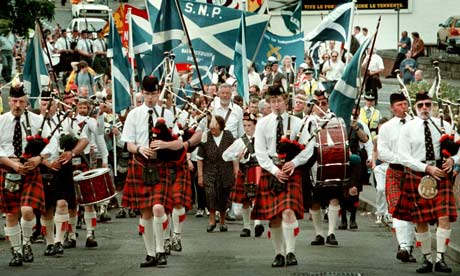
Having listened to Alex Salmon of the Scottish Nationalist Party who is speaking to journalists about the separation of Scotland from the rest of the UK, one is left with the impression that the Scots would be better to go it alone.
One of the problems we have with our current set up is that the structure of Westminster was built on the grand old days when we had an Empire and responsibility across the world. Our politics were as much focused overseas as within the country and because the participants, the politicians, were were from the grand old families with business connections affected by overseas trade the need to keep the trade sweet was a priority over the conditions within the country and therefore the needs of "the people" were often overlooked. Much has changed and a wider democratic mandate has meant that a wider audience has demanded a say in the governance and the benefits that that governance bequeaths.
The Scots are by nature and by geography a separate entity and their views on the social aspects of their constituency is very different from the "Nobel Structure" we have in Westminster.
One often witnesses the social divide in the Mother of all Parliaments, the wealth and the educational assumptions that a certain class of people are born to. The Scottish Parliament seems on the other hand to be made up of the rank and file of the people they represent and therefore their policies are more in tune with the majority. The democratic deficit has long been evident where the working class have returned the Socialist year in year out but only to be defeated by the entrenched political class (representing all parties) in the South of England.
I would go so far to say that Politics is a game in Westminster whilst it represents the "families interest" in Scotland.
Subscribe to:
Posts (Atom)